Celsius to Fahrenheit Convert
- 4.2
- Rating
- 100.00K
- Installs
- Free
- Price
 Analysis by App-foxy
Temperature conversions are one of those small problems that become surprisingly annoying when they appear several times a day. A recipe uses Fahrenheit, a weather report uses Celsius, a travel message includes a different scale, or a science exercise expects the other unit. I have often known the conversion formula and still wanted a quicker way to get the answer without stopping to calculate it. Celsius to Fahrenheit Convert is built for exactly that narrow task, and its value comes from removing that repeated mental interruption.
After using it, my impression is straightforward: this is a focused weather utility rather than a full weather service. It does not try to tell me whether it will rain, show radar, or replace a forecast app. Instead, it gives me a direct way to convert temperatures between Celsius and Fahrenheit. That limited purpose is also its main strength. The app from Webtoweb is free to install, suitable for everyone, and available for devices running Android 7.0 or later. Its current version is 1.4.3.
How Celsius to Fahrenheit Convert fits into everyday use
I find a dedicated converter most useful when I already have a temperature and need to make sense of it without breaking focus. For repeated tasks, I’d also jot down a few familiar reference points so I can spot an implausible entry before relying on the converted result. That practical routine helps explain where this small tool earns its place—and where a broader app is the better fit.
You May Also Like

 Blood Strike: 2.5 Anniversary
Blood Strike’s Loadouts Turn Every Drop Into a Tactical Gamble
A close look at Blood Strike’s custom loadouts: how fast access to signature weapons reshapes its battle royale rhythm, rewards preparation, and narrows the gap between fights.

 Pandora - Music & Podcasts
Pandora’s Music Is Easy to Start, but Harder to Recover
Pandora’s strength is its low-effort path from a seed to a station. Its weak spot is how much confidence it asks you to place in connection, setup, and quiet recovery.

 8 Ball Pool
 Is Built on Rivalries, Rematches, and Routine
A close look at the rivalries, rematches, shared routines, and unanswered safety questions that turn a quick pool match into a persistent mobile community.

 Samsung Music
’s Quiet Strength Is Playing What You Already Own
Its reach comes less from spectacle than from dependable access to a personal library. That simplicity is both the app’s strongest retention engine and its ceiling.

 AccuWeather: Weather Radar
AccuWeather Review: A Quick, Clear Forecast for Everyday Decisions
For everyday plans, the best forecast is the one you can understand quickly. AccuWeather makes rain timing, radar, and local conditions easy to act on, with a few trade-offs.

 Hill Climb Racing
Why Hill Climb Racing Still Turns Crashes Into One More Run
A tiny car, a bumpy hill and one more upgrade: Hill Climb Racing keeps resurfacing because its simple chaos makes every near-miss feel personal.
More From Our News Desk



The recurring problem is small, but real
The formula itself is not difficult. To convert Celsius to Fahrenheit, I multiply by nine, divide by five, and add thirty-two. The reverse conversion requires subtracting thirty-two and multiplying by five over nine. The trouble is not understanding the mathematics; it is using it quickly, accurately, and repeatedly when my attention is elsewhere.
That is where this app makes sense. I can open a dedicated converter instead of searching the web, asking a voice assistant, or typing a formula into a calculator. A general search may return a useful answer, but it also brings extra pages, advertisements, and opportunities to enter the wrong unit. A calculator is flexible, yet it makes me remember the correct order of operations. This utility is more direct because its entire purpose is temperature conversion.
I also appreciate that it avoids the common mistake of treating a temperature as if it were an ordinary unit conversion. Celsius and Fahrenheit do not scale from the same zero point, so simply multiplying by a fixed number is wrong. A purpose-built converter keeps the offset in the calculation. For everyday decisions, that matters more than the apparent simplicity of the task.
My first useful setup was almost immediate
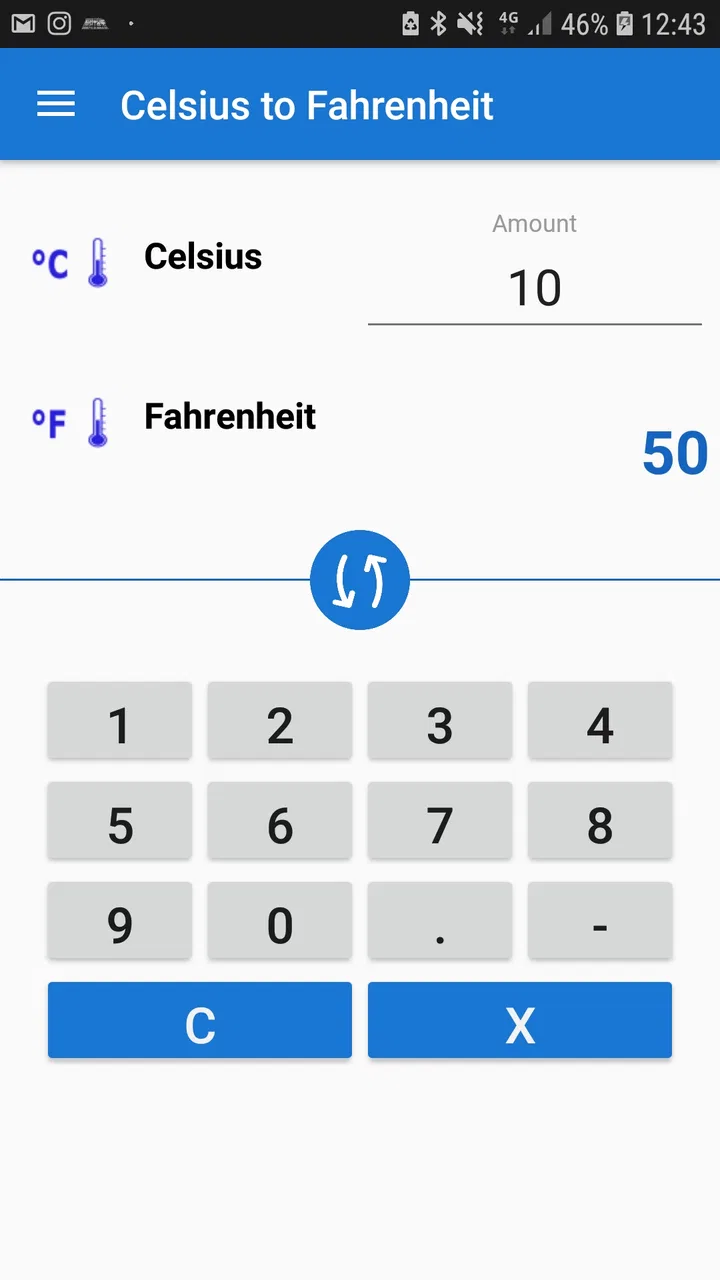
The first thing I looked for was whether the app felt like a tool or a miniature weather platform. It clearly belongs in the tool category. The store summary describes conversion in both Celsius and Fahrenheit, and that two-way approach is important. I do not want to convert only from the unit I happen to see most often; I need to move in either direction depending on the source.
There is no learning curve worth worrying about. I can treat it as a quick reference for a single value rather than something that needs a personal profile or a long setup process. That makes it especially suitable for occasional users who might not remember the formula between uses. It also works well for someone helping a child with homework, checking a cooking instruction, or comparing a temperature with a friend in another country.
One practical habit is to decide which unit I want before entering the number. That sounds obvious, but it prevents the most common user error: reading the result as though it were still the original scale. When I am switching between a weather report and a recipe, I use the source unit as my starting point and then check that the result is labeled in the destination unit. The app’s narrow focus makes this workflow easier than using a blank calculator.
Useful scenarios beyond checking the weather
The most obvious use is travel. If I am visiting a country that uses Fahrenheit while I normally think in Celsius, a quick conversion helps me interpret a forecast or decide what to wear. The reverse is just as useful when a visitor sends me a temperature from a Fahrenheit-based region. This is not a replacement for local weather information; it is the bridge between two ways of describing the same conditions.
Cooking is another realistic case. International recipes often use different temperature scales, and an oven setting is not something I want to estimate casually. I can use the app to convert the stated temperature before preheating, then return to the recipe without doing arithmetic beside a hot oven. The same workflow applies to instructions for food storage or preparation when the source comes from another country.
Health-related situations require more care, but the converter can still be useful for understanding a temperature mentioned by someone abroad. If a person tells me a reading in Fahrenheit and I normally use Celsius, the app can help me understand the number quickly. I would not use a conversion tool as a substitute for medical advice or a reliable thermometer, though. Conversion changes the unit; it does not validate the measurement or explain what it means.
Schoolwork provides a different benefit. Students can use the app to check a result after working through the formula by hand. I think that is a better learning workflow than copying the answer immediately: calculate first, compare second, and investigate any difference. The tool is then a verification aid rather than a way to avoid understanding the relationship between the scales.
Where it saves time and where it does not
The strongest advantage is the reduction in small decisions. With a search engine, I have to phrase the question correctly. With a calculator, I have to remember the formula. With mental arithmetic, I risk a careless error. A dedicated converter removes those steps and keeps the task centered on the temperature itself.
That benefit becomes more noticeable when conversions are repeated. Someone translating a recipe, checking several weather values, or preparing a worksheet may not want to calculate each result manually. The app is also easier to hand to another person because the purpose is immediately clear. There is less explanation needed than with a general-purpose calculator.
At the same time, it is not automatically faster than every alternative. If I already have a calculator open, or if I only need one rough estimate, mental shortcuts can be enough. I sometimes remember useful reference points: zero Celsius is thirty-two Fahrenheit, and a warm room near twenty Celsius is roughly in the high sixties Fahrenheit. For exact work, however, I prefer the dedicated conversion tool rather than guessing from a familiar benchmark.
The app’s narrow scope also means I should not expect it to solve the larger problem of understanding weather. A converted value tells me the equivalent number, not the humidity, wind, feels-like temperature, forecast trend, or local conditions. If my real question is whether I need an umbrella or a coat, a full weather app is the better choice. Celsius to Fahrenheit Convert is useful only after I know the temperature I want to translate.
Three practical habits that make it more useful
First, I use it as a confirmation step when a number seems surprising. A result that feels too hot or too cold may indicate that I entered the wrong scale, not that the weather is unusual. Checking the original source and the destination unit together prevents a simple labeling mistake from becoming a bad decision.
Second, I keep the app for situations where internet searching feels excessive. A temperature conversion does not need a news page, a forecast, or a long explanation. Opening a specialized utility is a cleaner workflow when I already have the number and only need its equivalent. This is particularly helpful when I am working from a printed recipe, a message, or an offline document.
Third, I use it to build intuition rather than relying on it blindly. After converting a few familiar values, I start recognizing approximate relationships between the scales. The tool remains useful for precision, while repeated use makes future estimates quicker. That combination is more valuable than treating every conversion as an isolated button press.
What the audience figures suggest
The app has a 4.2 average from around three thousand ratings, with over one hundred thousand installs. Those figures suggest that it has found a real audience despite its deliberately limited purpose. I would interpret that as evidence of usefulness for people who want a small, dedicated converter, not as a reason to expect the breadth of a major weather platform.
It has been available since April 20, 2018, and the developer is Webtoweb. The age rating is Everyone, which fits the simple educational and practical nature of the tool. Its free price makes it easy to try for a one-off need, although in-app purchases are listed at $2.99 per item. Because the basic purpose is so focused, I would pay attention to which parts are included before assuming that every possible convenience is free.
Limitations I noticed before recommending it
The biggest limitation is not a defect in the conversion itself; it is the app’s lack of broader context. Someone searching for a weather app may expect current conditions, forecasts, alerts, maps, or location-based information. This utility should not be judged by those standards because it addresses a different problem. Still, users need to choose it with that distinction in mind.
It is also not the right tool for a long list of mixed measurements if I need a complete unit-conversion workspace. A general converter may handle length, weight, volume, pressure, and temperature in one place. That option is more convenient for technical or household projects involving several unit types. The trade-off is that a broader app usually requires more navigation before reaching the exact conversion I need.
For professional, scientific, or safety-sensitive work, I would verify important results independently. A conversion app can be convenient, but the surrounding measurement still matters: the thermometer’s accuracy, the source’s rounding, and whether the value is being used for a specific standard. I see this app as a dependable everyday aid, not as the sole control in a process where a small numerical mistake could have serious consequences.
Another consideration is the in-app purchase model. The app is free, but individual items may cost $2.99. That does not automatically make it poor value, yet it means I would check the available experience before committing to any paid option. For a simple conversion, I would want the free functionality to be enough for my normal needs; otherwise, a calculator or another free utility might be more practical.
Who should install it, and who should skip it?
I would recommend it to travelers, home cooks, students, parents helping with homework, and anyone who regularly receives temperatures in the “wrong” scale. It is especially suitable for people who want a dedicated answer without learning a formula or navigating a large weather dashboard. The free entry point also makes sense for occasional users who do not want to buy a specialized device or subscribe to a broader service.
I would skip it if I want forecasts, alerts, location tracking, or a complete weather picture. I would also choose a broader unit converter if temperature is only one part of a larger measurement task. Finally, if I convert values only once every few months and already have a reliable calculator habit, installing a separate app may not add much value.
My final view after using the converter
Celsius to Fahrenheit Convert succeeds because it respects the size of the problem. It does not turn a basic calculation into a complicated dashboard, and it gives me a focused way to move between the two temperature scales. The time saved is modest on any single use, but the friction removed is genuine whenever the same conversion keeps interrupting a recipe, trip, lesson, or conversation.
My recommendation is therefore specific rather than universal. If you need a simple temperature bridge and prefer a dedicated tool over search or manual arithmetic, this app is a sensible free option to try. If you need weather information around the number, or a full collection of measurement tools, choose something broader. In my experience, its best quality is not the promise of doing everything; it is making one recurring task quick, clear, and easy to repeat.
FAQs for Celsius to Fahrenheit Convert
01What is Celsius to Fahrenheit Convert used for?
Celsius to Fahrenheit Convert is a simple temperature conversion tool for users who need to change values between Celsius and Fahrenheit. It can be useful when reading weather reports, cooking recipes, science assignments, travel information, or product instructions that use a different temperature scale. The app focuses on quick results without requiring manual calculations or complicated settings.
02How do I convert a temperature with Celsius to Fahrenheit Convert?
After opening the app, enter the temperature in the available Celsius or Fahrenheit field, depending on the conversion you need. The corresponding value is then calculated using the standard conversion formula. The interface is designed to be straightforward, so even first-time users should be able to obtain a result quickly without navigating through multiple menus or creating an account.
03Does Celsius to Fahrenheit Convert work offline?
For basic temperature calculations, an internet connection is generally unnecessary because the conversion formula can be processed directly on the device. This makes the app convenient when traveling, studying, cooking, or working in places with limited connectivity. However, availability of certain additional features, advertisements, updates, or links within the app may depend on the version installed.
04Is Celsius to Fahrenheit Convert accurate?
The app uses the standard mathematical relationship between Celsius and Fahrenheit, making it suitable for everyday temperature conversions and general educational use. Results may be displayed with decimal places to provide greater precision, although the number of visible decimals can depend on the app’s formatting. For laboratory, medical, or industrial work, users should still verify the required precision.
05Is Celsius to Fahrenheit Convert free to download and use?
The app may be available as a free download, but the exact conditions can vary depending on the Android or iOS version and the store listing. Some editions may include advertisements, optional purchases, or different feature limitations. Before installing, check the official download page for current pricing, supported devices, permissions, privacy details, and any requirements stated by the developer.
Pros
- Converts Celsius and Fahrenheit quickly with minimal input.
- Simple interface is easy for beginners to understand.
- Useful for cooking
- travel
- weather
- and schoolwork.
- Provides accurate results for everyday temperature conversions.
- Works well for users who need a focused conversion tool.
Cons
- May feel unnecessary if your phone already includes a calculator.
- Limited usefulness for users who need many unit conversions.
- The app may offer little value beyond basic temperature conversion.
- Results depend on entering the temperature in the correct field.
- Some users may prefer a conversion tool with more advanced options.

Celsius to Fahrenheit Convert
Gallery